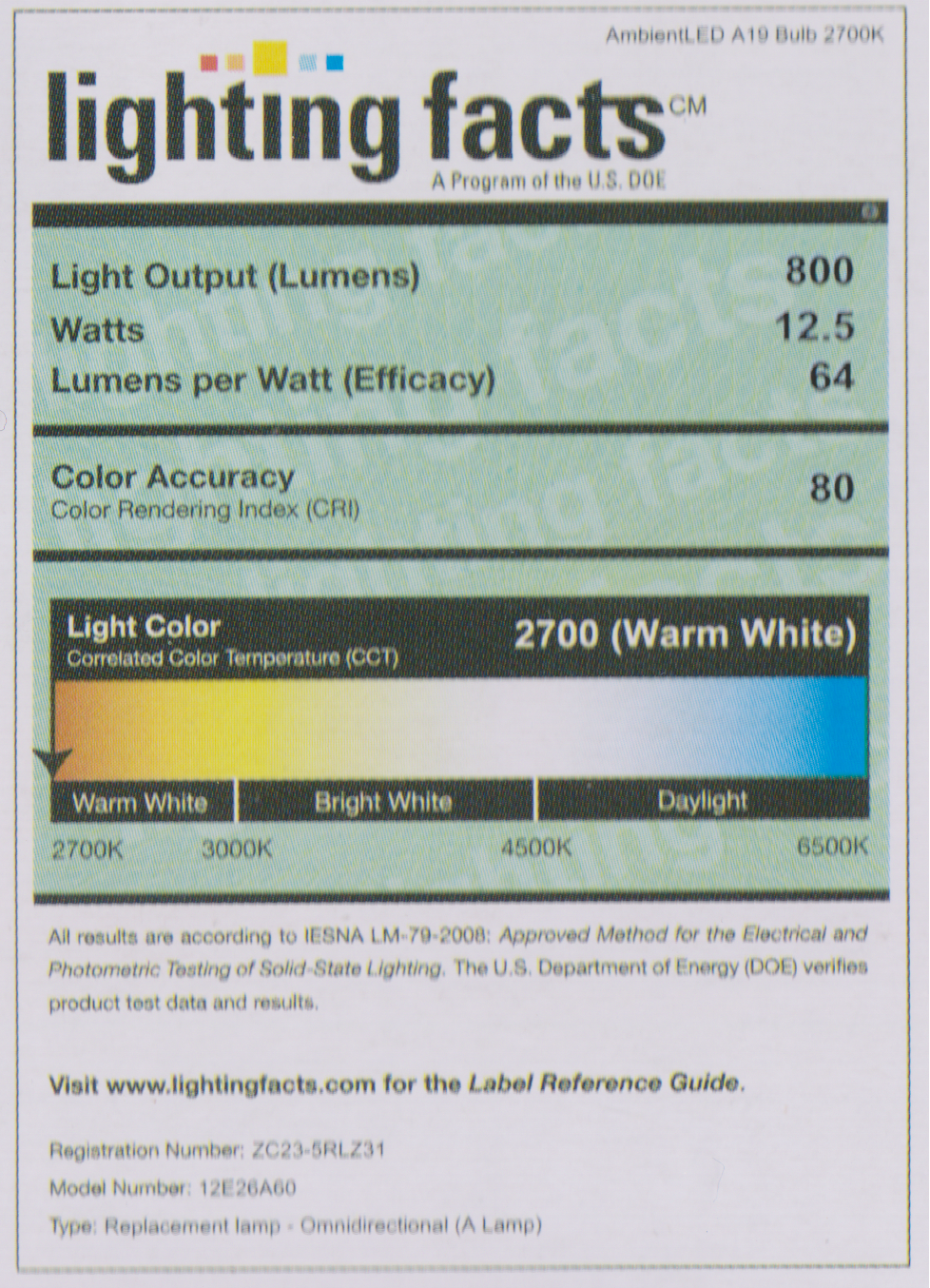
Every LED bulb sold in Poland carries a Kelvin value on the box — typically 2700 K, 3000 K, 4000 K, or 6500 K. Those numbers describe colour temperature: how warm or cool the light appears. Choosing the wrong one for a room does not damage anything, but it produces a result that feels persistently off without an obvious explanation.
What the Kelvin scale actually describes
Colour temperature borrows from physics. When a black body radiator is heated, it glows at different colours depending on its temperature in Kelvin. At 2,700 K it glows amber-orange; at 6,500 K it glows close to overcast-sky blue-white. LED bulbs are not actually black bodies — they produce a defined spectrum — but the Kelvin number approximates the visual equivalent.
The practical takeaway: lower Kelvin = warmer, more orange; higher Kelvin = cooler, more blue-white. Incandescent bulbs that Polish homes used for decades ran at around 2,700 K, which is why LED equivalents at that rating look familiar.
The four common ranges
- 2,700 K — Warm White: The standard incandescent equivalent. Amber-tinted, flattering on skin and wood surfaces, relaxing. Standard for living rooms, bedrooms, and hallways.
- 3,000 K — Soft White: Slightly cooler than warm white, still in the comfortable range. Works well in kitchens and bathrooms where a slightly crisper look is useful without feeling clinical.
- 4,000 K — Cool White / Neutral White: Closer to midday sun at high altitude. Clean and clear, good for task lighting in workshops, kitchens, and home offices. Feels cold in relaxation spaces.
- 6,500 K — Daylight: Blue-shifted, high energy appearance. Accurate colour rendering useful for art studios, garages, and detailed technical work. Wrong for any space used in the evening.
Room-by-room recommendations
Living room — 2,700 K
The living room is where most households spend their evenings. A 2,700 K ambient source creates the warm cast that cues the body toward rest. If you add a reading lamp, 2,700–3,000 K works equally well — the slightly higher temperature gives a touch more clarity for text without breaking the warm atmosphere.
Mixing 2,700 K and 4,000 K sources in the same room produces a mismatched look — different surfaces will appear different colours under different fixtures, which reads as untidy even when the room is clean.
Kitchen — 3,000–4,000 K
Kitchens involve close visual work: checking whether meat is cooked, identifying the colour of herbs, reading small print on packaging. A cooler temperature helps. 3,000 K is a good compromise — the space still feels domestic rather than institutional, but the light gives enough clarity for food preparation.
Under-cabinet task lights in a kitchen at 4,000 K paired with a ceiling ambient at 3,000 K is a common and effective combination. The task layer is slightly cooler, the ambient slightly warmer, and the difference reads as natural because it mirrors how daylight comes through a window at different angles.
Bathroom — 3,000–4,000 K
Bathroom mirrors need enough colour accuracy to make grooming decisions reliably. A 2,700 K mirror light flatters but distorts — it makes skin look warmer than it is, which can result in mismatched makeup and missed shaving nicks. 3,000 K is a reasonable middle ground. 4,000 K is more accurate but can look harsh if it is the only light in the room.
Look for bulbs with a CRI (Colour Rendering Index) of 90 or above for bathroom mirrors. CRI measures how accurately a light source renders colours compared to natural daylight. A bulb can be 2,700 K and have a CRI of 80 (accurate enough for a living room but poor for a mirror) or a CRI of 95 (very accurate). CRI is separate from colour temperature.
Bedroom — 2,700 K
The blue-wavelength component of light above 4,000 K suppresses melatonin production. This is well-documented in chronobiology research — the retinal cells that drive the circadian clock are most sensitive to wavelengths around 480 nm, which are prominent in cool-white light. For a room used for sleep, 2,700 K is the correct choice.
If smart bulbs are fitted (see the smart bulb comparison), schedules that shift the colour temperature from 4,000 K during the morning to 2,700 K by late evening automate this transition without manual adjustment.
Home office — 4,000 K for overhead, 3,000 K for accent
A home office requires sustained visual attention. 4,000 K desk or overhead light reduces eye strain during long working sessions by providing enough contrast between text and background. However, a fully 4,000 K office used into the evening disrupts the wind-down process. A practical approach: use a 4,000 K desk lamp pointed at the work surface, and a 2,700–3,000 K ambient source for the rest of the room.
Hallways and staircases — 2,700–3,000 K
Hallways are transition spaces. They do not need high task illuminance — 100–150 lux is sufficient — but they benefit from a welcoming temperature that matches the rooms they connect. If the living room is 2,700 K and the kitchen is 3,000 K, a hallway at 2,700 K looks and feels continuous.
Consistency within a room matters more than the number
The single most common colour temperature mistake in Polish apartments is mixing warm and cool sources in the same sight line. A 2,700 K ceiling pendant combined with a 6,500 K desk lamp visible from the sofa creates a visual conflict that the eye registers as unpleasant without the observer necessarily identifying why.
Before buying new bulbs, read the Kelvin value off the ones already installed. Match all sources in the same room to within one band — 2,700 K and 3,000 K can coexist; 2,700 K and 6,500 K cannot.
Warm-white LED equivalents to incandescent
When replacing incandescent bulbs, 2,700 K is the standard match. Polish hardware chains (Castorama, Leroy Merlin, OBI) stock warm-white LED equivalents in E27, E14, and GU10 bases at prices between 4–15 PLN per bulb depending on wattage and brand. Philips, OSRAM, and domestic brands like Kanlux all offer consistent 2,700 K output with CRI ≥ 80.
For fixtures where CRI matters (bathroom mirrors, art display, kitchen work surface), budgeting for CRI ≥ 90 bulbs at 10–25 PLN each is worth the additional cost — the visible improvement in how food, skin, and materials look under the light is immediate.
Tunable white: when a single number is not enough
Tunable white bulbs adjust colour temperature across a range — typically 2,200–6,500 K — via an app or dimmer. They cost more than fixed-temperature alternatives (usually 30–80 PLN per bulb), but they eliminate the need to commit to one temperature at installation time. They are particularly useful in multipurpose rooms that serve as both workspace and relaxation space on the same day.
Most major smart bulb ecosystems now include tunable white options. See the ecosystem comparison article for a breakdown of which platforms handle tunable white most reliably.